
Your landscape lighting budget needs to cover fixtures, power equipment, wiring, installation, and the finished yard around them. A product price is a useful starting point, but your installed total depends on where the lights go and the work needed to connect them.
For your Lewes home or another Sussex County community we serve, start with the routes and gathering areas you want to use after dark. Just Imagine offers landscape lighting design and installation as part of its outdoor services. This guide explains how to build a budget and compare the scope behind a price.
What does a lighting equipment price tell you?
At the time of writing, VOLT lists its Max Spread Kit (Black) from $799.99. The manufacturer describes six path lights, LED bulbs, a 150-watt transformer, 100 feet of cable, connectors, and stakes. Configuration and current pricing should be checked on the product page.
This is a retail equipment reference, not a Just Imagine quote, a brand commitment, or a Lewes installed-price range. A completed installation also needs a layout, site assessment, labor, and any additional work for your yard. The example helps show why a budget based only on the price of individual fixtures can miss other components.
Separate three costs when planning: the system you buy, the work to install it, and the electricity and care needed afterward. Keep optional accents separate from the lighting you want along everyday paths and steps.
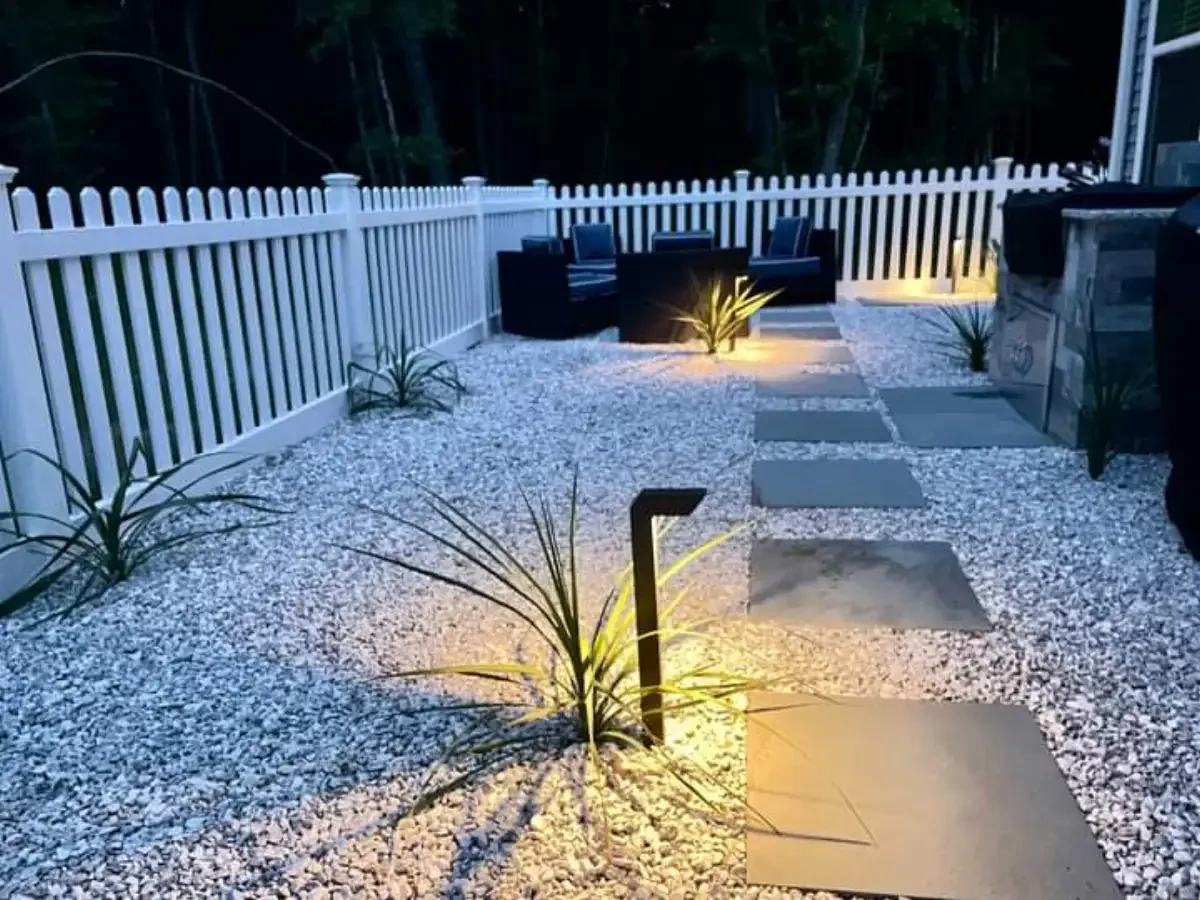
Why the installed cost changes from yard to yard
Fixture type, count, and mounting
Path lights, tree accents, and lights built into steps serve different purposes. Compare the exact models, light output, mounting accessories, and locations. A fixture count alone leaves out the difference between placing lights in an accessible planting bed and fitting them into existing hardscape.
Cable routes and power equipment
A compact group of lights near the power source and fixtures spread across a larger yard need different wiring plans. WAC Lighting's cable-length guidance explains that voltage drop depends on cable length, cable size, and total fixture load. Those relationships help explain why the same number of lights can require different equipment and cable arrangements.
Ask the installer to identify the proposed transformer, cable routes, and any work at the power source. Existing equipment should be assessed for condition and compatibility before its reuse becomes a budget assumption. Electrical work and any applicable approvals should have a named responsible provider and a clear place in the proposal.
Finished paving and installation access
When lighting is planned with a new paver patio or walkway, wiring access can be considered before the surface is finished. Adding lights afterward may involve crossing or working around existing paving. Ask what disturbance is expected and whether restoring lawn, planting, or paving is included.
Controls and separate lighting zones
Decide whether you need a shared on/off schedule or separate control of the path, patio, and accent lighting. Have the proposal name the controls and explain any dimming or app functions, compatibility requirements, and recurring charges if applicable. Price those choices before treating them as part of the base system.
How to keep the budget focused
Start with the route from your house to the places you use in the evening. Then identify the steps, seating, and one or two features you most want to see. Ask for a price for that defined layout, with additional accents shown as options.
A phased plan is worth discussing when you want a larger system later. Have the installer explain what future capacity and access would involve, then compare that preparation with the cost of revisiting finished areas. Additional lights still need a compatibility and load review; spare transformer capacity alone does not settle the whole expansion.
For the visual side of the decision, our guide to reviewing lighting from the house and patio covers viewpoints and evening use. Keep underwater pool fixtures or changes to pool equipment as an explicitly defined scope rather than assuming they are included with surrounding garden lights.
What will the lights cost to run?
Virginia Cooperative Extension's energy-use guidance calculates electricity consumption from wattage and operating time, then applies your utility rate. For lighting, use the complete system's input demand, including power equipment and controls.
For illustration, a system drawing 60 watts for five hours a night over 30 days uses 9 kWh. At an assumed $0.20 per kWh, that is $1.80 for the month. These are example inputs, not a Delaware utility rate or a forecast for your installation.
A transformer's capacity rating does not mean it continuously consumes that amount. Ask for the proposed system's expected input demand and use the rate on your own bill. Longer operating hours increase energy use; a schedule should reflect when you actually want the lights on.
Allow for care as well as electricity. Ask about cleaning, aiming adjustments, replacement access, and the selected equipment's warranty conditions. Get any offered maintenance service and its price in writing rather than assuming ongoing visits are included.
Compare proposals for the same finished result
A useful estimate connects a marked layout to named fixtures and quantities, power equipment, controls, installation work, and restoration. Check which electrical work, approvals, final aiming, and operating instructions are included. Identify allowances and exclusions before comparing totals.
Bring photos of the yard, an approximate layout, your preferred operating hours, and details of existing lighting. Mention planned patio or walkway work and whether you want the whole system now or in phases. Those details give the estimate a clearer starting point than a fixture count alone.
Landscape Lighting Cost FAQ
How much does professional landscape lighting cost in Lewes?
An installed price needs a fixture layout and a review of your yard, power, wiring routes, and finished surfaces. A retail kit price covers equipment and does not establish the cost of a completed local installation. Request a written estimate that separates equipment, installation, electrical work, and restoration.
Why can two estimates with the same number of lights differ?
Fixture models, mounting locations, cable routes, transformer capacity, controls, and access can differ even when the fixture count matches. Compare the proposed layout and named equipment, then check whether both prices include electrical work, surface restoration, and final aiming.
Can I reuse my existing landscape lighting transformer?
Possibly, after the installer checks its condition, capacity, output, and compatibility with the proposed fixtures and controls. Keep reuse conditional until that assessment is complete, and ask for replacement as a separate option if needed.
How do I estimate the electricity cost of landscape lighting?
Multiply the complete system input watts by daily operating hours and days of use, divide by 1,000, then multiply by your electricity rate per kilowatt-hour. Use the actual system demand, including transformer and control consumption; a transformer capacity label is not its constant electricity use.