
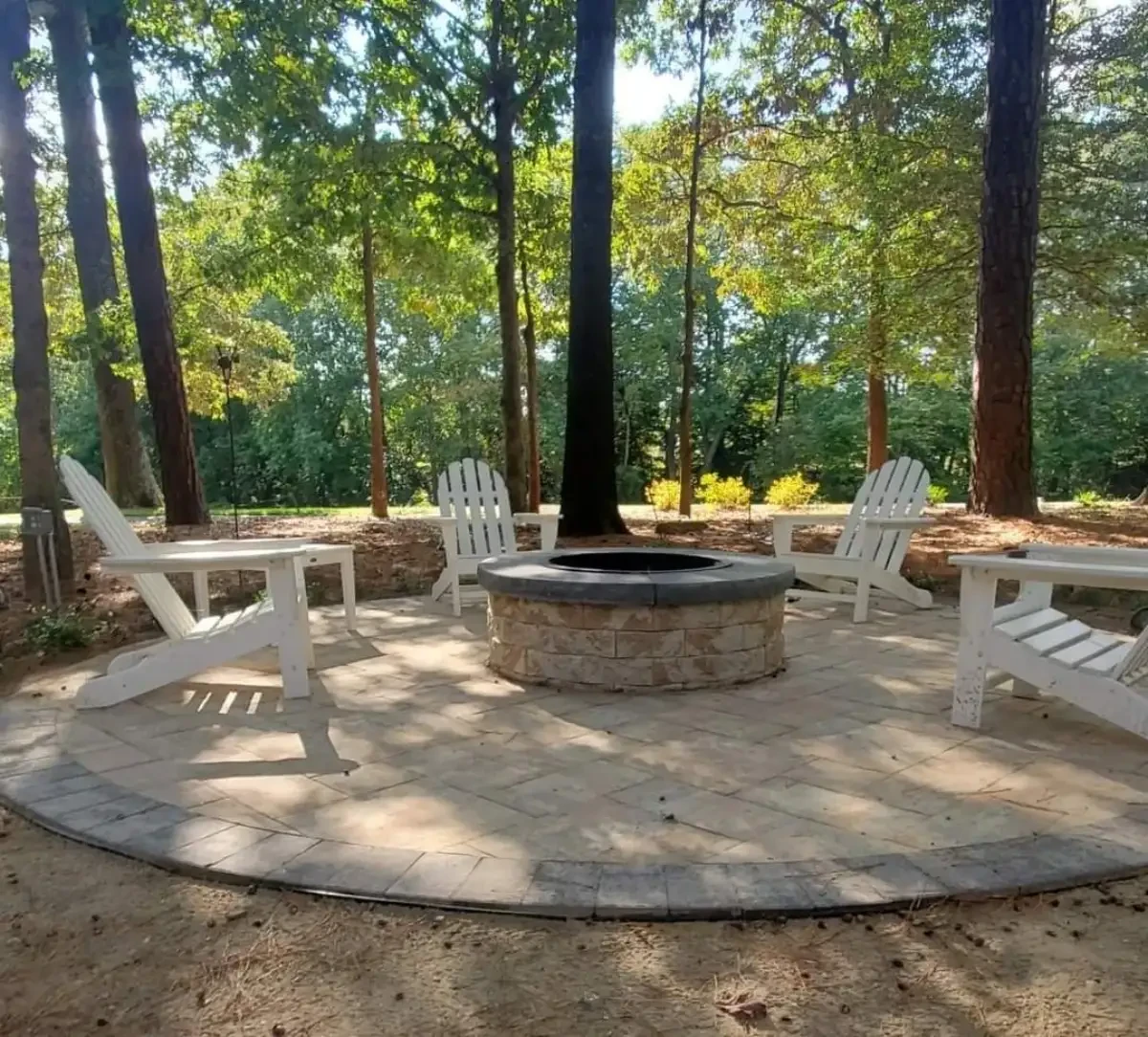
A fire feature changes the way people gather on a patio. A circle of chairs encourages conversation around a central point; a fireplace gives the seating area a front and a backdrop. Before choosing a shape or finish, decide where people will sit, how they will reach the space, and how the feature relates to the house and surrounding outdoor areas.
Choose the arrangement before the finish
A fire pit creates a central gathering point
A round or square pit can organize seating around several sides. Leave the required space around the selected appliance and keep a clear route into and out of the group. The chairs, walking route, and fire feature together establish the needed footprint; the diameter of the pit alone does not.
Look at the patio with chairs occupied and pulled back. A location that appears centered on an empty drawing may interrupt the route between the door, grill, and lawn. Movable furniture and built-in seating create different opportunities for changing the arrangement.
A fireplace gives the space a direction
A fireplace can act as the visual end of an outdoor room, with the main seating facing it. Its height and mass become part of the view from the house, including when the fire is not in use. Consider that view alongside the hearth, supporting construction, appliance requirements, and relationship to nearby structures.
A fire table changes the furniture plan
A table-style feature combines a flame area with a surrounding surface. Review the selected product’s intended use and required clearances. Do not assume that every edge is suitable for serving, seating, or other uses simply because it resembles an ordinary table.
Compare fuel choices with the actual property
The fuel and appliance need to be selected together. A natural-gas option depends on the property’s supply and a suitable connection designed and installed by the responsible professional. A propane option needs the appropriate supply, location, ventilation, and access arrangements for that appliance. Neither the town name nor a nearby gas line confirms what is available for your project.
Wood-burning features involve smoke, embers, fuel storage, and ash handling. Consider how those practical responsibilities fit the way you expect to use the space. Confirm current local and community restrictions for the property before choosing the equipment. The proposal should identify the selected feature and installation responsibilities rather than assuming one fuel is the company’s default recommendation.
Let the site and product guide placement
Nearby buildings, vegetation, boundaries, overhead structures, furniture, and walking routes all belong in the placement discussion. Required separations and installation details must come from the selected equipment and applicable requirements. A general backyard article cannot establish a safe clearance for every fire feature.
Exposure also matters. Observe where wind moves through the yard and where guests tend to sit. Discuss those conditions with the project team and equipment supplier. Accessories should be used only where appropriate for the selected product; an improvised screen or surround is not a substitute for a suitable location and installation.
Coordinate the surface, seating, and surrounding work
Compare the feature with the patio and nearby retaining edges before choosing finishes. A quiet paving field can give a textured surround more emphasis. A contrasting border can define the gathering area without adding another wall. Review samples in the setting so the colors and textures relate to the home.
The visible finish is only part of the construction. Supporting work, approved components, utility arrangements where applicable, drainage, and access for maintenance should be resolved as part of the design. This is especially useful when a feature joins an existing patio: the estimate should identify what remains, what must be altered, and how the surrounding area will be restored.
Keep operation and care tied to the equipment
Retain the selected product’s operating and care instructions. Have problems with burners, ignition, fuel connections, electrical equipment, or structural components assessed by an appropriately qualified professional. Maintenance intervals and methods vary; a universal annual checklist does not replace the instructions for the installed system.
The U.S. Consumer Product Safety Commission’s backyard fire-pit guidance warns against using gasoline to start or restart a fire and adding liquid fuel after an ignition attempt. It also advises against burning when wildfire risk is high. Review that guidance alongside the product instructions and current local restrictions.
Compare the complete project scope
A useful estimate identifies the actual appliance or system, surround and finishes, supporting construction, any utilities, adjoining paving, and restoration. Confirm responsibility for any required approvals and professional work. These details explain differences between proposals more clearly than an unsupported regional price range.
For a fire feature within a larger outdoor living plan, begin with the gathering area you want and the routes around it. Share photographs and your project priorities with Just Imagine to discuss the patio, seating, and connected outdoor spaces.